↓
 

Carolyn Mulford

Carolyn Mulford

  • Home
  • About
  • Show Me Mysteries
    • Series Overview
    • Show Me The Murder
      • Show Me the Murder Chapter One
      • Discussion Topics for Show Me The Murder
      • Ordering Information
      • Excerpts from Reviews
    • Show Me the Deadly Deer
      • Show Me the Deadly Deer: Chapter One
      • Discussion Topics for Show Me The Deadly Deer
      • Ordering Information
      • Excerpts from Reviews
    • Show Me the Gold
      • Show Me the Gold Chapter One
      • Show Me the Gold Discussion Questions
      • Ordering Information
      • Reviews
    • Show Me the Ashes
      • Show Me the Ashes: Chapter One
      • Show Me the Ashes: Discussion Topics
      • Show Me the Ashes: Ordering Information
    • Show Me the Sinister Snowman
      • Show Me the Sinister Snowman – Chapter One
      • Show Me the Sinister Snowman: Discussion Questions
      • Show Me the Sinister Snowman: Order Information
    • Talks and Workshops
    • Blog: Writing Mysteries
    • Writing Tips & Resources
  • The Feedsack Dress
    • The Feedsack Dress
    • Ordering Information
    • Historical Background
    • Chapter 1: The Feedsack Dress
    • Discussion Topics for Students
    • Discussion Topics for Book Groups
    • The Feedsack Dress Blog
  • Thunder Beneath My Feet
    • Thunder Beneath My Feet
    • Ordering Information
    • Historical Background
    • Chapter One: Thunder Beneath My Feet
    • Suggestions for Students
    • Discussion Topics for Book Groups
    • Blog: Historicals
  • Other Writings
    • Short Stories
      • “An Aura of Death”
      • “Crossing the Bridge”
      • “Leftovers”
    • Works in Progress
  • News
    • Latest Postings
    • Events
    • Reviews of Carolyn’s Books
    • Media Materials – Images
    • Media Materials – News releases
  • Contact

Author Archives: Carolyn

Post navigation

← Older posts
Newer posts →

Reviewers Value Books’ Characters

Carolyn Mulford Posted on December 22, 2014 by CarolynDecember 22, 2014

Yesterday two reviewers gave me an early Christmas gift, appreciation of the people who inhabit Show Me the Gold, the newly released third volume of my mystery series.

In Living on the Page: Personal Journal of Author Sandra Parshall, the Agatha winner wrote, “The plot has enough twists, turns, and blind alleys to keep readers turning pages, but the greatest strength of Carolyn Mulford’s writing is her gift for creating likable characters with the kinds of flaws that make us all human. … Highly recommended for readers who love character-driven stories with realistic small town settings.”

If you need a model for writing book reviews, read this one and others at http://livingonthepage.blogspot.com/2014/12/review-show-me-gold.html.

Few newspapers give space to writers these days, but Columbia Tribune arts reporter Amy Wilder surveyed the local scene literary scene in “Missouri scribes fill shelves with varied volumes.” She even read Show Me the Gold before she interviewed me.

She focused on the fast pace, the sense of place, and my characters. She wrote, “Mulford is interested in, and draws a lot of inspiration from, social dynamics she has observed in people throughout her life — both while she lived and worked abroad and at home.

“While many things have changed” since the author left Missouri decades ago, “I don’t think people have changed very much,” she said. “I didn’t have an awareness of as many of the strains of Missouri life as a child, as I do as an adult — particularly as an adult who’s come back; you see a place more clearly when you return to it after being away.”

You can read the full article at http://www.columbiatribune.com/arts_life/ovation/missouri-scribes-fill-shelves-with-varied-volumes/article_4a7f2a0d-7e14-5858-86b1-ecff2f4e7041.html.

Those two perceptive reviewers made December 21 a great day for me.

—Carolyn Mulford

Posted in News, Reviews of Carolyn’s books, Show Me Series

Glimpses of Chile

Carolyn Mulford Posted on December 15, 2014 by CarolynDecember 15, 2014

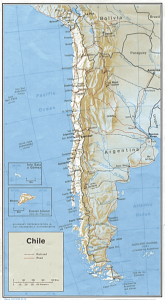
Chile_relief_map_1974For decades I traveled Peace Corps style: riding buses and trains, staying at B&Bs and austere hotels, and buying most of my food in markets and small restaurants. Traveling on a low budget took extra time, planning, and effort, but it enabled me to experience life in unfamiliar countries somewhat as the natives did.

Gone are the days. I’ve reconciled myself to touring with a group of curious, well-traveled retirees on two-week trips planned and directed by people who make sure hotels and restaurants meet high standards and know where to find a bathroom every two hours.

In November I took such a tour of Chile and Argentina, two countries I’d avoided in my do-it-yourself days because their governments made lots of people disappear. Comfort, congenial companions, and the organizers’ good mix of places and personal encounters made the trip enjoyable and stimulating.

What we saw and heard aroused my journalistic curiosity. I can’t satisfy that, but here are some glimpses of things in Chile that intrigued me.

Protests in Santiago

Although we saw the shacks that trumpet poverty on the way from the airport, most of Santiago looked like a pleasant modern city. Jacaranda bloomed in parks. Well-dressed people (almost all white) rode a clean, quiet subway. Restaurants (seafood is huge) and ice cream places abound. We had some really good ice cream in unfamiliar flavors, and lots of young (and not so young) people were eating cones in the street.

We saw many new high-rise apartment buildings, some near blocks of old mansions that had been turned to other uses—businesses, apartments, schools. Despite a high literacy rate, quality education is more goal than reality, we heard, with the public schools bad and the private ones expensive.

The most surprising, and encouraging, thing to me was the number of protests. For years after the 1973 CIA-assisted coup that ended with leftist president Salvador Allende’s death, protestors tended to vanish. Thousands of others fled the country, with some returning after the repressed but more prosperous citizenry astonished General Augusto Pinochet by voting him out of office in 1988. (The United States gets some credit for helping Chile improve its economy.)

When we went for a walk in the central area, unionized government workers were gathering with signs to push the legislators to put a pay raise in the new budget. Stilt-walkers and drummers added a festive air. We saw small groups of protestors marching in the street several times. Police were plentiful but not obtrusive. They didn’t wear riot gear or carry military arms.

My cynical reportorial self wondered—but couldn’t investigate—who really staged these peaceful scenes.

A British tourist told me he saw a different scene from his hotel window early one morning. Police used water cannon against a group of young protestors, targeting one man in particular. A Chilean said he was probably an anarchist making trouble. A defensive excuse? Probably, but anarchists (like looters) do mix with protestors.

Put the protests in Santiago in context. International television news was showing report after report of looters and arson in Ferguson, Missouri. For months the area police had shown they didn’t know how to handle demonstrations. When I lived in D.C., people were brandishing signs whenever I passed the White House.

Lakes and Volcanoes

One reason for the trip was to see Andean scenery. The warm-up was Chile’s low-lying agricultural heartland, where grapevines, fruit trees, and corn often line the highway. The first two provide major exports. I can testify that the fruit was excellent. My companions enjoyed the wines. As to the corn, it forms a major part of the local diet, turning up in casseroles, stews, and salads.

Osorno Volcano

Osorno Volcano

The most scenic area was to the cooler south around the pretty Patagonian resort town of Puerto Varas. Here our hotel looked across the huge Lake Llanquihue to the snow-topped, cone-shaped Osorno and the long, irregular Calbuco volcanoes. A few years ago an eruption spewed masses of sand-colored ash, most of which drifted east into Argentina. A ten-inch layer of ash drove nearby residents away and killed forests, crops, and the tourist trade. People have returned to the towns, and their beautiful gardens attest to the ash’s nutritional properties.

We made several interesting side trips.

• A horse-breeding ranch where huasos, a father and son, showed how they compete in rodeos quite different from ours. No roping, no bull riding, no bucking broncs. Competitors receive points for maneuvering a steer cuddled between their sidestepping Andalusian horses in prescribed patterns without harming it. Dressed in traditional garb that includes a flat-brimmed hat and a heavy, hand-woven poncho in the ranch’s colors, the horsemen eschewed lassos, and their large, round-tipped spurs didn’t harm the horses. A kinder and gentler rodeo tradition.
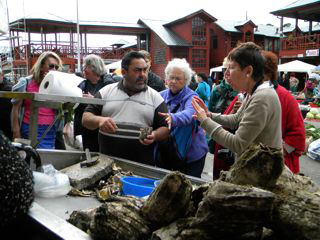
Market in Puerto Montt

Market in Puerto Montt

• A Saturday market in Puerto Montt where shoppers found a variety of  fresh seafood, large vegetables, and such other items as cheese. One of our most intriguing finds was a picoroco, a barnacle. The gray, tulip-shaped shell contained a white mass that shoppers took home or ate at the vendor’s stand with lemon juice. I preferred one of Chile’s favorite staples, empanadas. Turnover-sized and shaped, the empanadas held ground meat and potatoes, seafood, or cheese. In the market we saw some Native American faces.

• Petrohue Falls, a national park where green water from a lake rushes through lava formations. The low falls don’t equal the Great Falls of the Potomac near D.C., but the view of snow-capped volcanoes in the distance adds beauty.

Petrohue Falls

Petrohue Falls

In Puerto Varas, we were near the last-held ground of the Mapuche. The Spanish conquistadors and their descendants (plus some other Europeans) pushed the indigenous peoples who survived attacks and diseases toward the colder, less hospitable south just as we forced native tribes west. Today the Mapuche make up approximately four percent of Chile’s population, and they’re still struggling for their rights.

A Mapuche activist and culture preservationist talked to us about the Mapuche philosophy of life, government persecution for such acts as displaying their flag, and the ongoing fight to regain the land the Pinochet government took from them and awarded to his friends. The preservationist also noted that the Mapuche, by choice, have no written language. His grandparents say the words lose their true meaning on paper.

Our program director told us that eighty-five percent of Chile’s people have mestizo (mixed) blood, and that most of them deny it.

Like most other countries, Chile has a ways to go to build a true democracy. From my limited reading and observation, class constitutes a bigger problem than race, and economic and educational inequality presents one of the country’s greatest challenges. We face the same challenge.

I filtered my observations of Chile through others’ opinions and my experiences in other countries. The friendliness of the people made me root for them. The tour didn’t give me any expert knowledge, but those few days will help me understand what I read in their history and literature and what I see on the news.

—Carolyn Mulford
Posted in Events, News, Uncategorized

Library Journal and Gumshoe Like Show Me the Gold

Carolyn Mulford Posted on December 8, 2014 by CarolynDecember 15, 2014

One of the most important reviews for any author comes from the Library Journal. With Show Me the Gold to be released December 17, I started searching for the review, only to discover it came out October 1, 2014.

I’d missed two months of feeling good. The reviewer, librarian Viccy Kemp, put Phoenix Smith in the company of three of my favorite mystery protagonists: Marcia Muller’s Sharon McCone, Sue Grafton’s Kinsey Milhone, and J. A. Jance’s Joanna Brady. Those three writers pioneered in introducing intelligent, tough female investigators.

Here’s the review: “Ex-spy Phoenix Smith and Sheriff Annalynn Keyser respond to a call from a neighboring county in rural Missouri and kill two bank robbers trying to escape an abandoned farmhouse. Now they are the No. 1 targets of the surviving members of the Cantree clan. The third entry (after Show Me the Deadly Deer) in this character-driven series will intrigue fans of female PIs such as Sharon McCone, Kinsey Millhone, or Joanna Brady.”

The December issue of Gumshoe Review delighted me by posting two reviews. Both reviewers gave the nod not only to Phoenix and her two old friends but also to her canine sidekick, Achilles.

Verna Suit concluded, “The complex plot of Show Me the Gold finds Phoenix getting into lots of tight corners as she hunts down the elusive Cantrees. Frequently she is saved at the last second by the alertness of her Belgian Shepherd, Achilles, who easily earns his place in the series’ cover art. This very satisfying book traces the exploits of a 50-something single woman creating a new life for herself in small-town America; a CIA agent’s second act.” (See http://www.gumshoereview.com/php/Review-id.php?id=4513.)

Mel Jacob focuses on how Phoenix and her friends, Acting Sheriff Annalynn Keyser and singer/musical comedy director Connie Diamante, deal with crime and personal problems and what Achilles contributes. Jacob endorses Show Me the Gold by writing, “Readers will be looking forward to [the] next installment on Phoenix, Annalynn, Connie, and, of course, Achilles.” (See http://www.gumshoereview.com/php/Review-id.php?id=4682.)

Nothing beats knowing that readers enjoy my books.

—Carolyn Mulford

Posted in Mysteries, News, News releases, Reviews of Carolyn’s books, Show Me Series

“Aura of Death” Published in That Mysterious Woman

Carolyn Mulford Posted on December 5, 2014 by CarolynDecember 11, 2014

Experience has taught Jessica to keep secret her ability to see character-revealing auras. When an inexplicable cloud over a murder victim’s grave leads her to a killer, her unusual perceptions pose a dilemma and place her in danger.

I tell this tale in “An Aura of Death,” one of 27 short stories that appear in That Mysterious Woman, a new Shaker of Margaritas anthology published by Mozark Press in paperback and e-book editions (available on Amazon). Among the other writers are Paula Benson, E. B. Davis, Sharon Woods Hopkins, Edith Maxwell, Harriet Sackler, and Donna Volkenaant. The writers come from around the country and tell a variety of tales.

I write few short stories, and rarely anything that includes a supernatural element, but the idea of identifying a cold-blooded murderer and having no way to prove his guilt intrigues me. So does the ability, or burden, of seeing auras, which stems from a neurological condition called synesthesia.

Maybe some day Jessica will see another disturbing aura.

—Carolyn Mulford

Posted in Events, Media Materials, News, Short Fiction

Kirkus Praises Show Me the Gold

Carolyn Mulford Posted on November 13, 2014 by CarolynDecember 15, 2014

“Mulford confronts her troupe of reluctant crime solvers with plenty of action and a few surprises.”

So ends Kirkus Reviews’ 300-word review of Show Me the Gold, the third mystery in my Show Me series. Five Star/Gale, Cengage releases the hardback and e-book editions December 17.

As usual, Kirkus is the first pre-publication reviewer. The publisher sends paperback uncorrected proofs (often called advanced reader copies—ARCs) to national review publications three to four months before the release date.

I send out copies to my own list, which consists mostly of bloggers and newsletters. Few newspapers today carry staff-written book reviews. The reviews, and some interviews, that I generate will come later. So will comments on such sites as GoodReads and Amazon.

That later response makes the first review from a well-respected magazine particularly special.

The entire Kirkus review is posted at https://www.kirkusreviews.com/book-reviews/carolyn-mulford/show-me-the-gold/.

—Carolyn Mulford

Posted in Mysteries, News, Reviews of Carolyn’s books, Show Me Series

Show Me the Gold Giveaway on Goodreads

Carolyn Mulford Posted on October 18, 2014 by CarolynDecember 15, 2014

Want a chance to win an advance copy of Show Me the Gold? 

I’m offering five copies on Goodreads.com from now until November 29. If you’re not a member of this huge site for readers, you’ll have to join (pretty simple) before you can sign up for the giveaway.

If you’re already a member, go to https://www.goodreads.com/book/show/22945313-show-me-the-gold.

The third book in my series, Show Me the Gold will be released in hardback and e-book December 17. You can read chapter one and a summary on this site (go to Show Me Mysteries).

—Carolyn Mulford

Posted in News, Show Me Series

What I Learned in the Peace Corps

Carolyn Mulford Posted on October 18, 2014 by CarolynOctober 18, 2014

To take part in a panel on the Peace Corps Then and Now, I had to think about the lessons I learned during my two years teaching English in Ethiopia. In doing so, I realized that the experience affected not only my attitudes and interests but also the jobs I held in the years after that and the fiction I’m writing today.

In September1962, the Peace Corps responded to Emperor Haile Selassie’s request for secondary teachers by sending in 275 volunteers. We doubled Ethiopia’s secondary faculty. I taught eleventh grade English at the only high school in the mountainous Wollo province. We had approximately 1,100 students from grades seven to twelve.

From the beginning, the Peace Corps has been known as the toughest job you’ll ever love. We lived that slogan. Almost no one quit. Why did we go, and why did we stay? Adventure and service dominated for almost everyone. Add to that, some men wanted to avoid being sent to Vietnam, some volunteers saw the Peace Corps as a career stepping stone (one volunteer was aiming for the Presidency, and took a shot at it), and some wanted to clarify what they wanted to do. A number became teachers.

The crucial thing that kept us there was that we were going to, not escaping from.

For me, the Peace Corps wasn’t a career move. I had long planned to be a writer and editor. After I left, I didn’t stand in front of a classroom for many years. When I did, I taught writing and editing in graduate continuing education programs. Still hard work, but not nearly as hard as teaching in that high school.

The general lessons that I learned served me personally and professionally. Here are some of them.

Keep your head and cope with whatever impossible challenge arises. When you don’t have what you need to do the job, figure out another way to do it.

All peoples and individuals are different, all peoples and individuals are the same. If we listen and look for commonalities, we can work and play together with people of all races, cultures, and creeds. (Some of that creeps into my mysteries.)

Americans take for granted our nation’s privileges and resources, from our rich farmland to our Constitution to our diverse population

I acquired lifelong interests, including folklore (folk tales reveal culture and values even better than history does), international affairs (leading me to work for the United Nations and follow international news), travel (roughly 70 countries so far), and how governments work (and don’t).

I also have been enriched with lifelong friendships. What’s more, almost any gathering of returned volunteers gives a feeling of fellowship and commonality that I’ve felt with no other group, not even writers.

The experience also had direct affect on my professional life, beginning with winning my first job as n assistant editor on a national education magazine. The Peace Corps line on my resume continued to interest people as I applied for jobs and, as a freelancer, went after contracts. One contractor told me never to take off my resume that I helped build a school in a leprosarium. My carpentry was irrelevant but memorable.

The Peace Corps experience made me willing to take chances on being able to survive as a freelancer and being able to sell novels. I was unwilling to view money as more important than boredom.

—Carolyn Mulford

Posted in News

High Season for Sexual Assault on Campuses

Carolyn Mulford Posted on October 17, 2014 by CarolynOctober 17, 2014

Fall is high season for rape on college campuses because new students haven’t yet learned their geographical and social way, but sexual violence and harassment last all year.

Recent events have raised awareness of the severity of the problem locally and nationally, so my branch of the American Association of University Women scheduled the topic for its October program. I “volunteered” to moderate it, and I’m sharing my preparatory notes here.

One in five women suffer rape in their lifetime. Almost 80% of those victims are raped before the age of 25, and 40% before the age of 18.

Senator Claire McCaskill has led an effort to learn the extent of the problem on campuses in Missouri and around the nation, bring it to administrators’ and the public’s attention, and sponsor the Campus Accountability and Safety Act.

In July 2014, she released the results of the first-ever survey on the topic. Four hundred forty diverse four-year institutions responded.  The survey carries validity (I don’t know the margin of error) for colleges around the county.

The survey found that many institutions continually violate the law and fail to follow best practices in nearly every stage of their response to these crimes.

Perhaps that’s why only 5% of the victims report the crime.

The executive summary notes eight areas of concern, including the following highlights.

1. A Lack of Knowledge About the Scope of the Problem

The best way to learn the scope is to conduct climate surveys, but only 16% of the respondents were doing that.

2. A Failure to Encourage Reporting of Sexual Violence

Only half of institutions provided a hotline for survivors, and only 44% provided the option to report sexual assaults online. Roughly 8% did not allow confidential reporting.

3. A Lack of Adequate Sexual Assault Training 

More than 20% of institutions provided no sexual assault response training for faculty and staff.  More than 30% provided none for students.

4. Reported Sexual Violence Goes Uninvestigated 

Despite a federal law, more than 40% of schools had not conducted a single investigation in the past five years.  !!!!!

5. A Lack of Adequate Services for Survivors

Only 51% of schools reported offering the diverse services needed. Most institutions also failed to provide access to a Sexual Assault Nurse Examiner.

6. A Lack of Trained, Coordinated Law Enforcement 

   Law enforcement officials at 30% of institutions received no training on how to respond to reports of sexual violence, and 70% of institutions lacked protocols on how campus and local law enforcement should work together.

7. Adjudication Fails to Comply with Requirements and Best Practices

More than 20% of institutions gave the athletic department oversight of sexual violence cases involving student athletes.

8. Lack of Coordinated Oversight

Institutions are required to name a Title IX coordinator whose responsibilities include coordinating any investigations of sexual harassment and sexual violence.  More than 10% did not have a Title IX coordinator.

You can download the full report from http://www.mccaskill.senate.gov/imo/media/doc/SurveyReportwithAppendix.pdf.

And this doesn’t end with college. In researching my next mystery, I ran across some statistics about the long-term effects of sexual violence.

A survey conducted for the Centers for Disease Control found that women and men who experience intimate partner violence, sexual violence, and stalking suffer lasting health effects.

In women, those effects include increased rates of asthma, diabetes, and irritable bowel syndrome.

In men and women, those effects include more instances than other people of frequent headaches, chronic pain, difficulty with sleeping, activity limitations, and poor physical and mental health.

Time to get over the boys-will-be-boys mentality and assault the problem.

—Carolyn Mulford

Posted in News

The Fun Starts Before the Writing Begins

Carolyn Mulford Posted on September 21, 2014 by CarolynSeptember 21, 2014

This is part of the September 2014 Sisters in Crime (SinC) Blog Hop. Authors answer one of several questions. I chose to write about what part of the writing process I enjoy most.

The writing process breaks into three parts: coming up with the idea, writing the first draft, and revising until ready for readers.

Each part of the process delights and frustrates me because each one stimulates a different part of my intellect and emotions. For plain old fun and excitement, though, nothing beats that first step of choosing a story’s building blocks—usually who, what, and where.

Any of the three may spark an idea, but most sparks soon go out. Writing an 85,000-word mystery takes real commitment. My enduring ideas integrate characters, plot, and setting into a story I can’t resist telling either because I can’t imagine how it will end or, more often with mysteries, because I can imagine the ending but not how the characters will get there. Whichever it is, if I don’t think the journey will entertain and satisfy me, I won’t put words on paper.

Here’s how the three building blocks came together for my Show Me series. The idea for the protagonist sprang from a news story about an outed CIA covert operative, drew on my personal experiences in living abroad, and crystallized as I planned to move back to my home state, Missouri, after being away for decades. I had my major ongoing characters and the setting in a struggling rural county.

What took more time was working out a plot that fit the major characters and the setting. I don’t know either the people or where they live thoroughly until I’ve written many pages, of course, and they change somewhat from book to book, but I had to acquaint myself with their goals, flaws, and major personality traits before I wrote the first words of Show Me the Murder.

Some writers know their characters instantly because they and their friends are the characters. I don’t find myself interesting enough to appear in my fiction. While some of my friends and family members would qualify, I wouldn’t expose what makes them so interesting to the world. I create my characters from scratch, blending pieces of hundreds of people I’ve known to create complicated beings who intrigue and amuse me. I revel in exploring the motivations, reactions, and attitudes  of those who come to life on the page.

I approach setting in much the same way. I don’t stage a crime in a real place, but I try hard to reflect the region’s cultural and economic environment, including speech patterns and attitudes.

Ideas for plots often come from conversations with people around me and the local news. That includes not just crimes (e.g., meth cooking and importation in Show Me the Murder and rustling in Show Me the Deadly Deer) but economic and social problems (e.g., elder abuse in Show Me the Gold and racism in Show Me the Ashes, the upcoming books in the series).

Another factor to consider is whether the characters and setting will foster plots that will interest me, and readers, over several books. A part of the challenge is to find an idea you can expand on with pleasure and for profit for years.

—Carolyn Mulford

For other SinC Blog Hops, go to Judy Hogan’s  http://postmenopausalzest.blogspot.com (posted September 21, 2014), and Maya Corrigan’s “Writing While I Sleep” at  http://mayacorrigan.com/smorgasblog (postied September 21, 2014).

Posted in Basic Tools, Mysteries, Mysterious Ways, News, Show Me Series, Writing

Harlequin Will Publish My First Mystery in Paperback

Carolyn Mulford Posted on September 20, 2014 by CarolynSeptember 20, 2014

Harlequin Worldwide Mystery has acquired the right to publish the mass market paperback edition of Show Me the Murder.

The first book in my mysteries series, Murder came out in hardback in February 2013 and as an e-book in August 2013. Harlequin hasn’t set a release date, but the paperback probably will come out in mid or late 2015. The words will be the same, but the cover will be new.

Harlequin Worldwide Mystery issues a number of paperback reprints each month, and many of those books are sold to subscribers to its club (http://www.book-club-offers.com/worldwide-mystery/).

Why didn’t the original publisher put out the paperback edition? Five Star/Gale, Cengage doesn’t buy those rights. My contract called for the rights to the hardcover, trade paperback (larger than mass market paperback), large print, and e-book editions. I retained (but could not sell for one year after publication of the hardcover edition) the film, foreign print, audio, and mass market rights.

I’m open to an offer for film rights.

—Carolyn Mulford

Posted in Media Materials, Mysteries, News, News releases, Show Me Series

Jumpstarting the Stalled Plot

Carolyn Mulford Posted on September 2, 2014 by CarolynSeptember 2, 2014

Like most authors, I spend a lot of time and energy on the opening chapters. That’s where we hook the reader with a mix of plot, character, setting, and tone. The opening presents the greatest writing challenge. It’s also offers the most fun.

A lot of books founder after that sterling opening. For me, the trickiest part of a manuscript often comes when my protagonist, former CIA covert operative Phoenix Smith, starts gathering information and identifying suspects. She’s learning about the case, and research can slow the pace. If pages contain lots of dialogue and little action, the mystery reader slips off the hook.

Having struggled with this slowdown, I celebrated when Killer Nashville organizers assigned me to a panel on jumpstarting a stalled plot. The topic forced me to analyze how I deal with this common problem.

When I begin a book, I know—vaguely—how it’s going to begin and end. I anticipate a few specific events or encounters as milestones along the way. My dead zone falls in the early middle pages—say somewhere between 75 and 150—where Phoenix is running around tricking people into giving her information and figuring out what leads to follow. She hasn’t yet become an obvious threat to the villain, so the plot lacks the inevitable fast action of the last 50 to 75 pages. (Most of my manuscripts run 305 to 335 pages.)

Usually the storyteller’s sense of timing warns me to make something happen. A key sign that I need to pick up the pace is when a chapter ends without anything pushing the reader to say, “Well, just one more chapter.”

Years ago Janet Evanovich, author of the numbered Stephanie Plum series, told writers that when she didn’t know what would happen next, she blew up Stephanie’s car. That sudden, unexpected action became a running gag in her books.

The principle of surprising the reader holds true, but most of us can’t get by with blowing up more than one car. What I usually do is draw on one of three C’s: conflict, clues, and change. All three are constants in mysteries, of course, so I mean really big ones.

Conflict takes many forms, from a physical contest—a shootout, a car chase, a trap—to a psychological dilemma—opposing personal goals, ethical questions, gains vs. losses. Whatever the conflict, it has to grow out of that particular story and the specific characters.

Fortunately any book provides multiple sources of conflict: the villain, a witness, a suspect, the police, a loved one or friend or mentor or employer. And almost any protagonist experiences internal conflicts, but at some point the conflict has to become action, often when and in ways the reader isn’t expecting. In Show Me the Murder, Phoenix dreads attending a recital at the church, and encounters a hit-and-run.In Show Me the Deadly Deer, she responds to a call about a rabid deer and becomes a hunter’s target. In Show Me the Gold, she stops to check a camera left to catch vandals in a rural graveyard and disrupts the killer’s plans.

I work hard to conceal small clues, but one jumpstarter is revealing a major piece of evidence—a license plate, a weapon, a cell phone trace, a fingerprint, an alibi—that turns the story in a new direction.

In the manuscript I just finished, Show Me the Ashes, Phoenix deals with a cold case. She can’t find new evidence. The turning point comes when she realizes what’s missing.

Often Phoenix discovers a clue that contradicts an accepted fact or casts a different light on the connections between seemingly unrelated characters.

One big lesson I’ve learned: Don’t waste characters. If I give a character a name, you can bet that person will provide a clue, often disguised in humor and seemingly irrelevant at the time.

If all else fails, make a change. The most obvious ones are point of view (switching to another person) or time (a flashback or old letter). Thriller writers like those techniques, but I rarely use them.

I prefer switching from one narrative line to another. In Gold, that means going from the main plot of the aftermath of a bank robbery to a subplot, suspected elder abuse or pressure on Phoenix to get together with an admirer.

In Show Me the Ashes, I alternate two story lines, an imprisoned young mother’s (possibly) false confession and a series of increasingly bold burglaries.

Sometimes introducing a new setting or a new person to reveal a surprising twist moves the plot forward. I also like to change the tone occasionally. That usually involves a light scene in which my main characters either spar or work together in an unpredictable way.

No one thing works all the time.

—Carolyn Mulford

Posted in Mysteries, News, Show Me Series

My School Wardrobe

Carolyn Mulford Posted on July 30, 2014 by CarolynJuly 30, 2014

With school opening in about three weeks, the newspapers are full of ads of school clothing. In the mid-20th century, school kids had far fewer clothes, but we country kids started planning our wardrobes in the spring.  We had to. That’s when we began collecting the colorful cotton feedsacks that we would turn into blouses, skirts, dresses, and shirts.

A feedsack apron

A feedsack apron

The process began with the arrival of cartoon-cute baby chickens. The chicks lived in a sweltering brooder house, and you had to check the heat, water, and feed frequently.

When you bought the feed, you picked out the prettiest sacks and continued to collect them as the chicks grew into fryers and layers. A dress with a full skirt could take most of three sacks. Often feed buyers liked the same prints, so getting the ones you wanted could be difficult.

Every summer from nine to fourteen, I endured a 4-H sewing project using the feedsacks and, later, the new synthetic fabrics. Once we had the material for the clothes, we chose  patterns. These came on a flimsy paper easy to tear as you pinned the coded pieces to the cloth to cut out. Battle strategy is no more complicated than figuring out how to place the patterns on cloth so pieces will match and you waste no cloth.

Once you’d cut the pieces out, you pinned them together and then fit them. That usually required me to stand on a kitchen chair in my underwear and rotate as my mother moved the pins to get a proper fit. She always allowed a bit for growth. I basted some seams to rid of the pins before going to the sewing machine.

In some ways sewing resembles writing. You redo it until you get it right. But sewing machines take hand-and-foot coordination and have no delete button. The seams had to be perfect. That meant I ripped out almost every one at least once. The most frustrating parts were sleeves and zippers.

The final step was ironing out the many wrinkles. Ironing on a hot, humid day gives you a preview of hell. Today I buy nothing that requires ironing.

–Carolyn Mulford

Posted in News

Post navigation

← Older posts
Newer posts →

Latest Postings


The New Madrid Tremors Continue

Carolyn Mulford Posted on December 17, 2025 by CarolynDecember 17, 2025

Early December 16, 1811, the destructive New Madrid Earthquakes began. For more than two months people in southeast Missouri, northeast Arkansas, and western Kentucky and Tennessee endured fear and privations from three major earthquakes (above 7.5 on the Richter Scale) and another 20 almost as bad. Many of the roughly 2,000 smaller ones disturbed their days and nights. Eighteen of the quakes were so strong that they caused church bells to ring on the East Coast and made dishes fall from shelves in such places as the Executive Mansion. Seismologists still monitor the New Madrid Seismic Zone. They have detected … Continue reading →

Posted in Historicals, Thunder Beneath My Feet | Leave a reply

Celebrating Jane Austen’s 250th Birthday

Carolyn Mulford Posted on October 1, 2025 by CarolynOctober 1, 2025

This year Janeites around the world are celebrating Jane Austen’s 250th birthday (December 16, 1775). Although she wrote only six polished novels before her death in 1817, she has become one of the most popular novelists in history. (If Pride and Prejudice is the only title you can remember, refresh your memory at https://carolynmulford.com/writing/vacationing-with-jane-austen.) She may be more popular now than ever. That’s partly because the movie and TV adaptations of her books over the last 30 years have drawn and delighted readers not doing assignments. Another factor has been the proliferation of novels imagining the life of Austen’s characters … Continue reading →

Posted in Uncategorized

Creating a Canine Character

Carolyn Mulford Posted on August 28, 2025 by CarolynAugust 28, 2025

To help a friend worrying about “interviewing” pets for a community newsletter, I dug up my old guest blog for Wicked Cozy Writers on portraying a dog as a supporting character. Here’s an adaptation. Planning Show Me the Murder, I spent weeks envisioning three old friends reunited in their hometown: Phoenix, a wounded former CIA operative; Annalynn, a do-gooder whose husband died in a sleazy motel; and Connie, a struggling singer/music teacher. Mid book, a Belgian Malinois named Achilles popped up as a plot point—the only witness to a crime. Phoenix finds him shot, starved, and tied to a tree. … Continue reading →

Posted in Mysteries, Show Me Series, Writing

Celebrating July 4th by Making Ice Cream

Carolyn Mulford Posted on July 3, 2025 by CarolynJuly 3, 2025

In the 19040s, we celebrated July 4th by making ice cream. My mother saved extra milk, cream, and eggs to mix and heat with the junket, sugar, and vanilla.  She started soon after breakfast because the mix needed to set. Meanwhile my father cleaned up the green-painted wood freezer keg, and my younger sister and I brought a panful of cattle salt from the barn. Then the three of us took the pickup to the ice house in town to buy a 50-pound block of ice. My father used ice tongs to carry the ice to the pickup and, once … Continue reading →

Posted in Historicals, The Feedsack Dress, Young Adult

4-H and Sewing in the 1940s

Carolyn Mulford Posted on June 30, 2025 by CarolynJune 30, 2025

4-H came to my rural community about two years after World War II ended. We had no other youth organizations available, so 4-H, led by two wonderful (female and male) county Extension agents, made a huge impact on us children—and our parents. As I recall, the whole community met at New Hope School (grades one through eight) to hear the agents describe the program and recruit adult volunteers to lead projects teaching practical skills ranging from sewing to raising calves. Then all the dozen or so kids nine or older signed up, elected officers (an unfamiliar task), and took the … Continue reading →

Posted in Historicals, The Feedsack Dress

Follow Me

Follow Us on FacebookFollow Us on TwitterFollow Us on GoodreadsFollow Us on RSS

Archives

  • December 2025
  • October 2025
  • August 2025
  • July 2025
  • June 2025
  • April 2025
  • February 2025
  • December 2024
  • November 2024
  • September 2024
  • August 2024
  • May 2024
  • April 2024
  • March 2024
  • February 2024
  • January 2024
  • July 2022
  • January 2022
  • March 2021
  • December 2020
  • July 2019
  • April 2019
  • October 2018
  • June 2018
  • May 2018
  • January 2018
  • December 2017
  • October 2017
  • September 2017
  • August 2017
  • July 2017
  • May 2017
  • April 2017
  • March 2017
  • February 2017
  • January 2017
  • December 2016
  • November 2016
  • September 2016
  • August 2016
  • May 2016
  • April 2016
  • March 2016
  • February 2016
  • January 2016
  • December 2015
  • November 2015
  • September 2015
  • August 2015
  • July 2015
  • June 2015
  • May 2015
  • April 2015
  • March 2015
  • January 2015
  • December 2014
  • November 2014
  • October 2014
  • September 2014
  • July 2014
  • April 2014
  • January 2014
  • December 2013
  • November 2013
  • October 2013
  • September 2013
  • August 2013
  • July 2013
  • June 2013
  • May 2013
  • April 2013
  • March 2013
  • February 2013
  • January 2013
  • November 2012
  • October 2012
  • May 2012
  • April 2012
  • February 2012
  • September 2011
  • July 2011
©2025 - Carolyn Mulford

Site design by Karen McCullough
Contact Webmaster

Site Admin
↑